

Across Ontario, rising traffic volumes, tighter construction timelines, and increasingly complex urban work environments are putting added pressure on how work zones are planned and executed. For contractors, that means safety is no longer just a compliance requirement – it’s a critical component of project delivery.
In response, the province’s road building industry is striving to provide better protection for both workers and motorists through stronger safety cultures, improved training practices, and the growing use of smart work zone technologies.
“We are doing what we can to make sure our workers get home to their families and friends at the end of the day. That’s of the utmost importance to our company and our industry,” said Marc Maida, operations manager for the Mississauga-based paving firm Pave-Al Limited. “It’s about the safety of our people and it’s also about the safety of the public. You want to make sure that you’re not putting anyone at risk who is travelling through work zones.”
Travis Saunders, vice president of operations, Eastern Canada, for ATS Traffic, notes the buy-in for maximizing work zone safety is definitely there across the road building industry. “Now, it’s just about how do we get this done,” he said.
Safety improvements
Maida says there have been many improvements in work zone safety in the past 20 years. This includes more buffer areas being built into road construction plans as well as the greater use of heavy concrete or water-filled barriers to delineate and protect work zones. Maida says advance notice to motorists is one of the most effective ways to protect crews.
“Immediate and abrupt road closures can create panic in the travelling public, and sometimes that panic can result in negative impacts,” he said, adding Pave-Al frequently uses advance notification tools like variable messaging boards to alert motorists that they are approaching construction and they can expect delays or should use alternate routes. “What you don’t want are cars flying up at 100 kilometres an hour and drivers slamming on the brakes when they see brake lights,” he said.
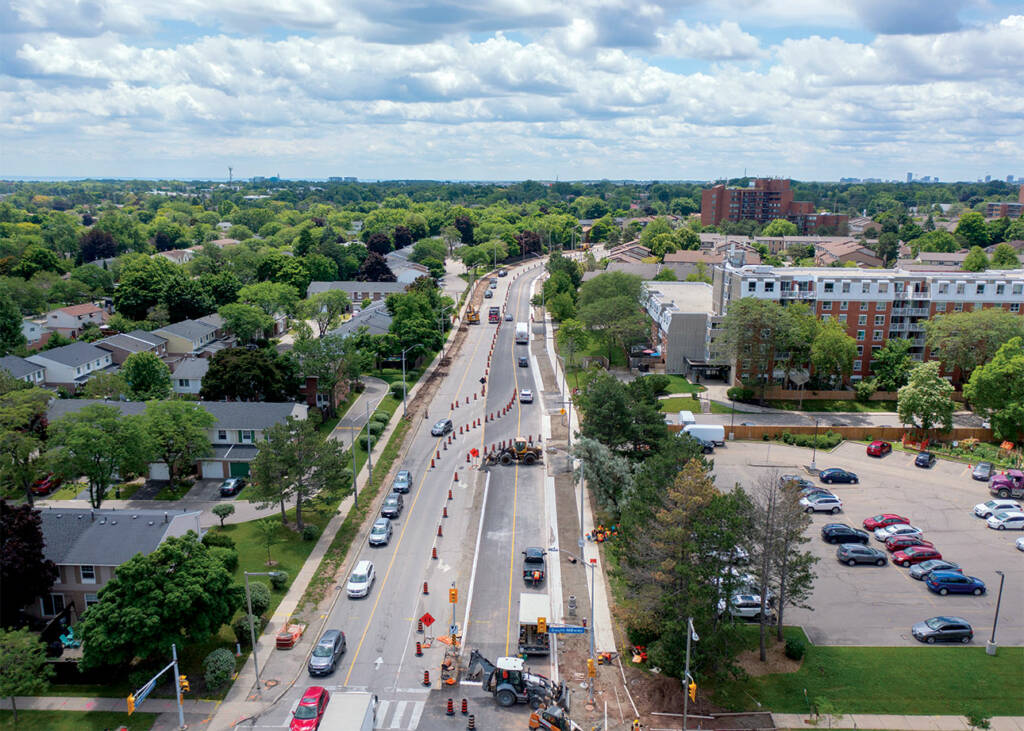
For contractors, these changes are also influencing how projects are priced and planned. Safety measures that were once considered enhancements are increasingly being treated as baseline requirements, with more emphasis placed on traffic management strategies, advance communication and the integration of protective technologies from the outset. Another important safety tool is automated flagger assistance devices (AFADs) – electronic, remote-controlled units that remove human flaggers from roadways, reducing the risk of injuries and fatalities.
“It gets the workers who are at the most vulnerable position out of the way of vehicles,” said Nick Turner, ATS Traffic’s director of business development. “We’ve taken a stance of pushing AFADs on every flagging job we can,” added Saunders. “We are prioritizing…technology that removes [people] from the side of the road.”
Saunders says he’d like to see Ontario follow the lead of other provinces like British Columbia, where it is mandated that road building contractors implement AFADs for traffic control whenever they can. Owen Heritage, managing director for Ramudden Services, says technologies like Intellitag – a cloud-based asset monitoring system designed to transform the way work zones are managed – are changing how work zones are monitored and managed in real time.
As soon as you enter a work zone, the risks of someone getting hurt, including yourself as a motorist, drastically increase, and I don’t think there’s enough education around that.
Travis Saunders, ATS Traffic
“A big issue on job sites is when people drive into work zones, resulting in incidents,” said Heritage. “This system provides live visibility and instant notifications, taking away that time gap between a problem and a fix.”
Ramudden’s Incursion Prevention and Warning System (IPWS) uses LiDAR to alert crews when a vehicle enters the work zone. “If somebody drives into a work zone, it notifies workers downstream that somebody’s coming who shouldn’t be there. It’s great for ramps and areas like that where people don’t see the motorists coming,” said Heritage.
While interest in these technologies continues to grow, adoption often comes down to cost, project scope, and owner requirements. As a result, contractors and traffic control providers are navigating how to balance innovation with practical implementation across a wide range of project types. At the same time, expectations around work zone safety are continuing to evolve, with both public agencies and contractors placing greater emphasis on proactive risk reduction rather than reactive response.
Safety culture
While new technologies can help advance work zone safety, the human element cannot be overlooked. It’s why, for road construction businesses like Pave-Al, instilling a powerful safety culture is so important.
“We’ve been working very hard for the last 10 years developing a strong safety culture that’s become deeply entrenched and is part of our day-to-day operation,” said Maida. “I think not only are companies more invested now in training and educating workers around site safety and traffic management, but unions are, as well. That’s something we welcome and encourage.”
That shift is also being reinforced by leadership at both the company and project level, where safety performance is increasingly tied to accountability, planning discipline, and day-to-day decision-making on site. Maida notes Pave-Al supports safety education and training through COR and IHSA programs for its workers, as well as those in supervisory positions.

Pave-Al’s strong commitment to safety was recognized at the Ontario Road Builders’ Association’s annual AGM and meeting in Toronto in February, when the company won a Routly Safety Award in Category 2. The award is given to contractors who accumulate more than 100,000 average person-hours without a lost-time injury for three consecutive years. Pave-Al has close to 300,000 person-hours without a lost-time injury.
Maida says while work zone safety is a day-to-day concern for everyone on the job site, it has to start with proper preparation. “Work zones create congestion and inherently they become high-volume traffic areas, so before we even set things up, it’s always at the forefront to delineate traffic and make sure that not only our work site is safe, but the public travelling through our site is safe as well.”
Maida says contractors are often responsible for key site safety decisions, including barriers and traffic delineation. He adds that work zone safety planning can happen early on, at project estimating or pre-project phases, and should continue throughout project execution to account for changing conditions. Increasingly, those considerations are being formalized earlier in the process, as part of bid strategy and project planning rather than being addressed once work is underway.
Public awareness lacking
Industry stakeholders note that improving work zone safety is not solely a contractor responsibility, but a shared one that depends on driver awareness, consistent messaging, and broader public understanding of how these environments function. Saunders and Heritage agree public awareness of safety risks associated with entering road building work zones is lacking.
“Your risks entering a work zone are far greater than just motoring along on a freeway or on a normal municipal road. As soon as you enter a work zone, the risks of someone getting hurt, including yourself as a motorist, drastically increase, and I don’t think there’s enough education around that,” said Saunders.
Heritage asserts this is especially important for people just starting to drive. “We need to do a better job of educating new motorists on how to interact with the work zone,” he said.
We need to do a better job of educating new motorists on how to interact with the work zone.
Owen Heritage, Ramudden Services
Maida says if there’s one thing he’d like motorists to keep in mind, it’s to try to be more patient. “People value their time, and you got to respect them for that. But we’re here to do a job that needs doing and work sites need to be kept safe and constructable, so what we’re asking of motorists is a little bit of patience,” he said. “That’s probably the biggest concern with the travelling public when we’re working out there.”
Maida maintains it’s only a small percentage of the motoring public that tends to lose their cool around work zones, but when they do, it can cause big trouble. “It’s those bad apples who can ruin it for everyone else,” said Maida. “I’ll give you an example. We had a freeway job last year that had two incidents where people were in traffic and just decided to pull a U-turn in the middle of the highway and got sideswiped. That creates an even bigger burden for the work site and the travelling public.”
As Ontario continues to invest in infrastructure renewal and expansion, the complexity and frequency of work zones is only expected to increase. For the road building industry, that makes ongoing improvements in safety practices, training, and technology not just important, but essential to keeping both workers and the travelling public protected.
