


Many transportation infrastructure announcements focus on major capital investments in new construction and large expansion or reconstruction projects. They demonstrate the provincial government’s financial commitment to addressing Ontario’s growing transportation needs.
However, some of the most valuable investments in Ontario’s road network rarely make headlines. Pavement preservation uses targeted treatments to extend pavement life before significant deterioration occurs. This “less visible” strategy is integral to extending the life of existing assets, improving network performance, and maximizing municipalities’ limited infrastructure funds.
The importance of pavement preservation
Unlike rehabilitation or reconstruction, pavement preservation focuses on keeping roads in good condition through timely, preventive treatments. “Pavement preservation treatments are cost-effective and environmentally sustainable strategies designed to extend the life of existing pavements,” said Jordan Willms, regional manager at Duncor Enterprises Inc. “They are applied to roads in good condition, for the purpose of keeping good roads in good condition for a longer period, extending service life, and optimizing costs over the full lifecycle of a road.”
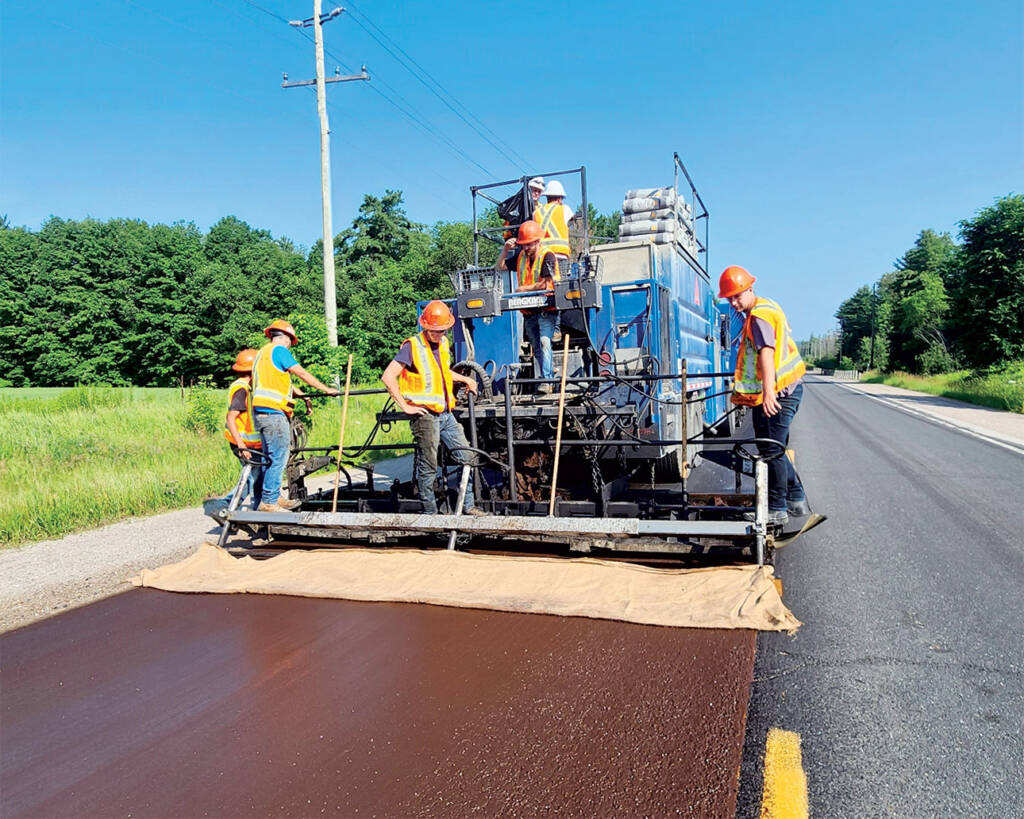
The long-term value of preservation can already be seen on Ontario roads. In 2013, Duncor completed a microsurfacing treatment on Davis Drive in Newmarket, Ont., between Highway 400 and Yonge Street. More than a decade later, the pavement continues to exhibit limited major surface distress, showing the potential long-term benefits of timely preservation treatments.
“As with any asset, if you build it right and do routine maintenance, it will last longer,” said Mat Nayagam, operations manager at The Miller Group. “You can extend the lifecycle from 20 to 30 years. Preservation puts you in a good position to avoid costly repairs in year 15 or 20. It is a proactive way of ensuring the road doesn’t get worse, as it helps prevent oxidation, potholes, and surface-related defects.”
The costs of waiting
Successful preservation depends on applying the right treatment to the right pavement at the right time. Preservation only works when treatments are applied before significant deterioration occurs. Once that window closes, costs rise rapidly. “When preservation opportunities are missed, roadways deteriorate faster and lifecycle costs increase,” said Willms. “Overall road network condition declines, ride quality deteriorates, and eventually the public becomes frustrated with the condition of the network.”
Water infiltration is a primary cause of the advanced deterioration of Ontario’s road network. When cracks develop, water seeps into the different layers of the pavement structure. Freeze-thaw cycles increase the rate of deterioration, leading to pothole formation and eventual structural failures. What could have been prevented or delayed with relatively inexpensive surface treatments may eventually require major rehabilitation or full reconstruction.
Spend a dollar today and it can save four dollars or more later.
Jordan Willms, Duncor Enterprises Inc.
“If you’re not applying preservation treatments, roads crack and water infiltrates the structure,” said Nayagam. “Once that happens, deterioration accelerates and costs increase much earlier in the pavement’s lifecycle.”
Waiting too long to preserve pavements also affects more than construction budgets. Reconstruction creates greater disruption for motorists, impacts surrounding communities and generates higher greenhouse gas emissions than preventive maintenance.
Getting more out of infrastructure funds
As municipalities face growing infrastructure deficits and limited budgets, pavement preservation offers one of the highest returns on investment available within transportation asset management. Figure 1 illustrates how timely preservation can significantly reduce lifecycle costs. When viewed through a lifecycle lens, the economics of pavement preservation are difficult to ignore.
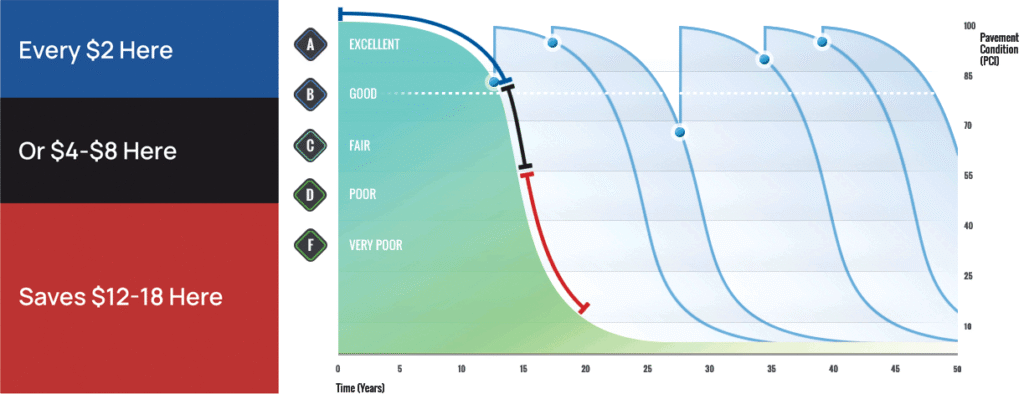
“Spend a dollar today and it can save four dollars or more later,” said Willms. “If owners are looking at their infrastructure investments with full lifecycle costs in mind, pavement preservation solutions help optimize both costs and asset life while maintaining better overall pavement conditions.”
The goal is not simply to preserve individual roads, but to improve the performance of the network as a whole by intervening before roads begin to fail. “Every year, [municipalities] should be making investments across the whole network instead of solving one asset problem at a time,” said Nayagam. “Maintaining pavement condition across the network is a much more effective way to manage infrastructure.”
The challenges of prioritizing preservation
For many municipalities, the challenge is no longer understanding the value of preservation, but finding the financial, political, and organizational capacity to act on it. If pavement preservation consistently delivers strong lifecycle returns, why isn’t it used more widely? The answer often has less to do with engineering than politics, public perception and the realities of municipal budgeting.
“Maintenance is an immediate cost that can be seen as unnecessary, especially when budgets are limited,” said Willms. “Political cycles are shorter than road lifecycles, so spending on preservation treatments can be unattractive to sitting governments or municipal councils.”
Highly visible capital projects attract more public attention and government funding, even when budgets are constrained. Smaller municipalities, in particular, may adopt a “worst first” approach, directing limited resources toward roads in the poorest condition rather than preserving those that are still performing well. A reactive approach may appear to stretch limited budgets, but allowing roads to deteriorate often increases long-term costs by forcing municipalities into more frequent rehabilitation and reconstruction.
Technical expertise can also be a barrier to broader adoption, particularly in smaller or more isolated municipalities. Without the experience or expertise to determine when preservation is the right solution, decision-makers may default to more familiar rehabilitation or reconstruction approaches.
“It’s not a one-size-fits-all solution,” said Nayagam. “It requires consultants, inspectors, and road designers to understand the specs, adjust the application rates, and determine the required emulsions and aggregates for the specific road conditions.”
Preservation technologies and philosophies have advanced
Although pavement preservation is a well-established practice, advances in materials, equipment, and lifecycle management continue to improve its effectiveness. Computers and automation enable operators to improve calibration and material placement, which produces longer-lasting results. Better emulsions, improved aggregate selection, and refined mix designs have increased performance. Industry understanding of lifecycle management and commitment to sustainability have also progressed.
If you’re not applying preservation treatments, roads crack and water infiltrates the structure. Once that happens, deterioration accelerates and costs increase much earlier in the pavement’s lifecycle.
Mat Nayagam, The Miller Group
“In Europe, preservation is increasingly viewed as part of carbon reduction and decarbonization strategies,” said Nayagam. “Extending pavement life means fewer major reconstruction projects, lower material consumption, and reduced emissions over the asset’s lifecycle.”
Preservation should not compete with expansion for transportation infrastructure budgets; rather, these options should complement each other. New roads will always be needed to support population growth, but an effective infrastructure strategy should include protecting existing assets. The goal is to maximize the value of every road already in service. That’s why pavement preservation is part of a proactive asset protection strategy.
Realizing the full value of pavement preservation will require funding models, asset management practices, and decision-making processes that allow municipalities to act before deterioration becomes visible. “Everyone pays for these assets,” said Willms. “It makes sense to preserve them proactively and maximize the value of every infrastructure dollar spent.”
